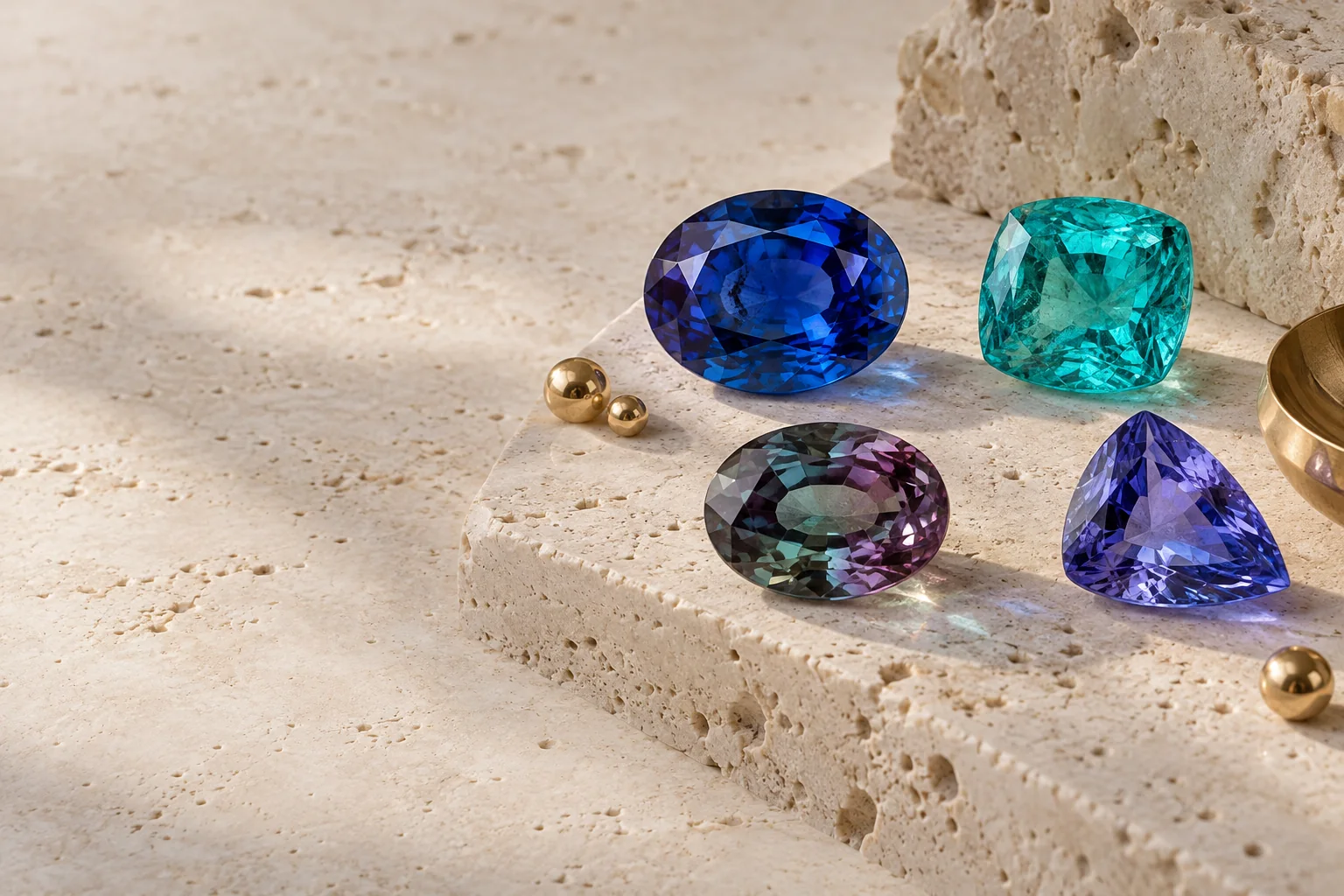
Luxury gemstones extend far beyond the traditional “big three.” This guide compares sapphires, Paraíba tourmaline, alexandrite, spinel, tanzanite and other high-end stones by rarity, colour, treatment, durability and the stories that place them in contemporary high jewellery.
Ruby, emerald and sapphire anchor the historic market, while exceptional Paraíba tourmaline, alexandrite, spinel, jadeite, opal and other rare gems can command serious collector interest. Luxury depends on exceptional quality, scarcity, documentation, design and provenance—not the species name alone.
The legacy of coloured gemstones
For much of history, colour came before mineral science. Blue gems signified heaven and authority, green stones fertility and renewal, and red stones vitality and power. Modern gemology later separated stones that earlier collectors grouped by appearance: ruby from red spinel, sapphire from other blue minerals, jadeite from nephrite.
That richer understanding has expanded high jewellery rather than diminishing its romance. A Kashmir sapphire can be prized for velvety blue, a Paraíba tourmaline for electric blue-green colour caused by copper, an alexandrite for changing between greenish and reddish appearances under different light, and a fine spinel for saturated colour without routine treatment.
Contemporary collectors increasingly combine origin stories, unusual colour and design. The best purchase joins emotional response with evidence: the gem should move you, and the report, treatment disclosure and craftsmanship should support the price.
High-end luxury gemstones compared
| Gemstone | Signature appeal | Market considerations | Wear and care |
|---|---|---|---|
| Sapphire | Velvety blue, plus pink, yellow, green and padparadscha colours. | Colour, cut, treatment and origin; unheated fine stones are rarer. | Hard and tough; strong choice for daily jewellery. |
| Paraíba tourmaline | Vivid blue to green colour associated with copper. | Colour, brightness, size, origin opinion and treatment; fine material is scarce. | Good for jewellery with sensible protection from impact and heat. |
| Alexandrite | Distinct colour change between different light sources. | Strength and quality of colour change, saturation, clarity, size and origin. | Durable enough for many jewellery uses. |
| Spinel | Red, vivid pink, cobalt blue, lavender and other refined colours. | Colour dominates; origin and cobalt attribution can matter for exceptional stones. | Good hardness and toughness for regular wear. |
| Tanzanite | Blue-violet to violet-blue, discovered commercially in the 1960s. | Colour, size, cut and treatment; geographic supply is limited to Tanzania. | More vulnerable to knocks and thermal shock; protective settings advised. |
| Jadeite | Translucent imperial green, lavender and other colours; deep cultural importance. | Colour, transparency, texture and treatment classification are crucial. | Very tough, but treatments may dictate care. |
| Fine opal | Play-of-colour that shifts with angle and light. | Pattern, brightness, body colour, stability and origin. | Sensitive to impact, heat and dryness; careful wear. |
Also consider demantoid garnet, tsavorite, aquamarine, red beryl, chrysoberyl cat’s-eye and exceptional zircon. Rarity alone does not create beauty or liquidity; niche stones reward specialist knowledge.
How luxury gemstone value is judged
For most coloured stones, colour is the leading factor: hue, tone, saturation and evenness. Cut determines whether that colour remains bright across the face or falls into a dark centre or transparent window. Clarity standards vary by species; inclusions expected in emerald would be judged differently in aquamarine.
Rarity can increase sharply with size, especially when fine material is seldom found in larger crystals. Treatment status, geographic origin, laboratory documentation, signed provenance and historical ownership can add further layers. Unlike round-brilliant diamonds, coloured stones do not share one universal grading system, so numerical seller grades should be treated cautiously.
Auction results for singular stones do not create a simple retail price list. They may reflect provenance, competition, rarity and an exceptional moment. Use comparable quality, not headlines, when setting a buying budget.
Gemstone treatments and laboratory reports
Heat treatment is common and accepted for many sapphires and rubies. Emeralds are often clarity enhanced. Sapphire may also be diffusion treated; ruby can be fracture filled; jadeite may be bleached, polymer impregnated or dyed; topaz can be irradiated; and some gems can be coated. Treatment can be stable or delicate and can change value by orders of magnitude.
For an important purchase, obtain a report from an independent gemological laboratory that identifies the material, states whether it is natural or laboratory-grown, and lists detectable treatments. An origin opinion may be worthwhile when the price depends on locality. A report is not an appraisal and does not replace a written invoice or condition assessment.
Luxury gemstone buying checklist
- Define the intended use: daily ring, occasional jewel or collection stone.
- Choose colour in multiple lighting conditions before chasing origin or carat.
- Ask which treatments are present, whether they are stable and how they affect care.
- Match the report to the stone and verify its number with the issuing laboratory.
- Inspect cut, windowing, extinction, inclusions and durability at normal viewing distance and under magnification.
- Use a setting that protects vulnerable edges and suits the gem’s toughness.
- Request an itemised invoice, return period, provenance documents and insurance valuation where appropriate.
Explore our dedicated guides to emeralds, rubies and diamonds for deeper buying advice.
How to care for a gemstone collection
There is no universal cleaning method. Warm soapy water is safe for many untreated gems, but porous, fracture-filled, coated or heat-sensitive material may require professional care. Keep laboratory reports with photographs and measurements, store pieces separately, and tell a jeweller about all known treatments before repair. Schedule condition checks for high jewellery that is worn often.
Luxury gemstone frequently asked questions
What is the rarest luxury gemstone?
There is no single practical answer because rarity depends on species, quality, size and market availability. Fine alexandrite, red beryl and exceptional Paraíba tourmaline are among stones frequently described as very rare, but documentation and quality remain essential.
Which coloured gemstone is best for an engagement ring?
Ruby and sapphire are strong candidates because corundum is hard and tough. Spinel and chrysoberyl can also work well. Emerald, opal and tanzanite need more protective design and mindful wear.
Do unheated gemstones always cost more?
Fine unheated ruby and sapphire may command premiums, but an unattractive unheated stone is not automatically more valuable than a beautiful treated one. Treatment type, disclosure and overall quality all matter.
Is a laboratory report the same as a valuation?
No. A gemological report identifies and describes the stone and detected treatments. A valuation estimates monetary value for a stated purpose and date.
Sources and further reading
Editorially reviewed 14 September 2026. Educational information only; seek an independent gemologist for a high-value purchase.