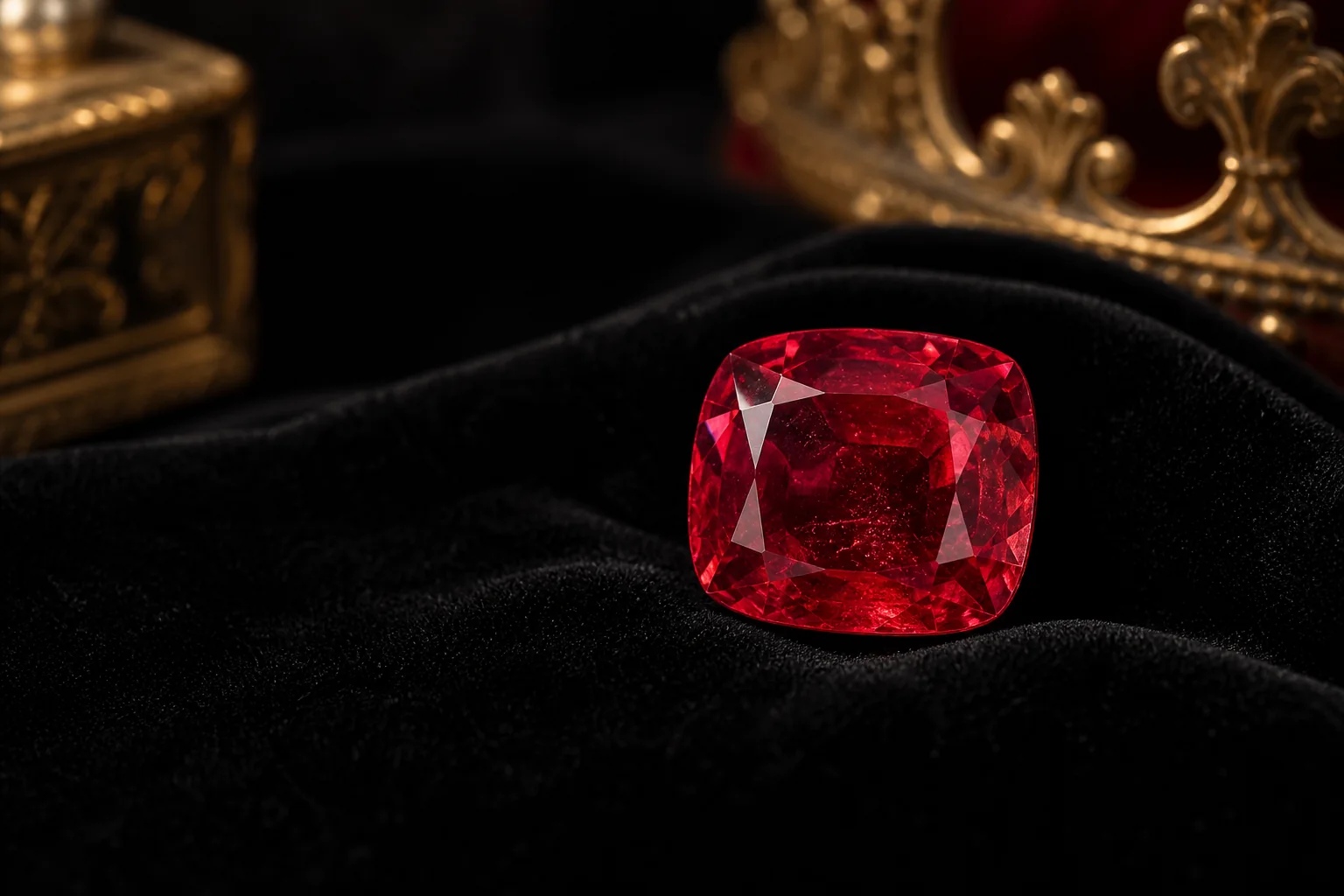
Rubies are the red expression of corundum and one of jewellery’s great measures of rarity. This ruby buying guide follows their legacy from historic Asian courts to modern high jewellery, then explains colour, origin, heat treatment, value, care and the checks every serious buyer should make.
Vivid, evenly distributed red colour leads, followed by transparency, cut, size and treatment status. Fine unheated rubies with respected laboratory reports can command exceptional premiums, but beauty and durability must be judged stone by stone.
The legacy of rubies
Across South and Southeast Asia, ruby became a symbol of vitality, protection and sovereign power. The historic deposits around Mogok in present-day Myanmar supplied stones celebrated for saturated red colour and fluorescence. Rubies travelled through court treasuries, ceremonial jewels and the workshops of European houses, often appearing beside diamonds to sharpen their red.
The gem’s history also teaches precision. Famous “rubies” in old collections were sometimes red spinels because early owners lacked modern mineral identification. Both can be magnificent, but they are different gem species. Contemporary laboratories now separate identity, treatment and possible geographic origin, turning legendary descriptions into testable evidence.
Modern production from Mozambique has reshaped supply since important deposits emerged in the twenty-first century. It has also widened the range of fine rubies available to designers and collectors while making origin and treatment reports central to high-value transactions.
Ruby colour, clarity, cut and carat
| Factor | Why it matters | What to inspect |
|---|---|---|
| Colour | The dominant value factor. | Hue from purplish red to orangy red, saturation, tone and evenness. The stone should remain lively rather than too dark. |
| Transparency | Controls brightness and visual depth. | Inclusions are expected, but haze, prominent fractures or a dull centre lower appeal. |
| Cut | Balances colour orientation, weight and light return. | Symmetry, attractive outline, an even face-up red and no large transparent “window.” |
| Carat | Fine ruby becomes much rarer at larger sizes. | Both weight and face-up dimensions; fine stones above one carat can be especially scarce. |
| Treatment | Materially affects rarity and value. | Whether the gem is unheated, heated, diffusion-treated or fracture-filled. |
“Pigeon’s blood” is a trade colour term, not a universal grade. Laboratories use their own criteria, and not every vivid red ruby qualifies. Never pay a premium for evocative language without the report, colour and beauty to support it.
Burmese, Mozambique and other ruby origins
Mogok, Myanmar holds unmatched historical prestige and is associated with rubies that can combine strong red colour and fluorescence. Mozambique is now a major source of gem-quality material, producing a wide range from commercial to exceptional. Vietnam, Thailand, Cambodia, Sri Lanka, Tanzania and other regions have also supplied notable stones.
Origin never guarantees quality. Two rubies from the same mine can differ greatly, while stones from different countries can look similar. An origin statement is an expert opinion based on gemological evidence, not a certificate of beauty. It becomes most relevant when a seller’s price depends on a prestigious geographic claim.
Ruby heat treatment and fracture filling
Heat treatment is widely accepted in the ruby market and can improve colour or clarity. An unheated fine ruby is rarer and may carry a substantial premium, but it still needs attractive colour, transparency and cut. A report stating “no indications of heating” is stronger evidence than a sales description.
Lead-glass or other fracture filling is a different category. It can make heavily fractured material look more transparent and can require special care; value is generally far below that of comparable untreated or conventionally heated ruby. Diffusion treatments can also alter colour. Ask for plain-language disclosure, an independent report and care instructions before committing.
Ruby buying checklist
- Choose the red you love before focusing on a country name.
- View the ruby in daylight-equivalent and warm indoor light; colour can shift with illumination.
- Inspect the centre for darkness, windowing, haze and durability-threatening fractures.
- Request an independent coloured-stone identification report for a significant stone.
- Confirm treatment status and possible origin on the report, not only the invoice.
- Compare total beauty and rarity at the same budget; unheated status should not excuse poor appearance.
- Record return terms, setting specifications, treatment disclosure and aftercare in writing.
How to care for ruby jewellery
Untreated and conventionally heated ruby is relatively hard and tough, making it suitable for frequently worn jewellery when securely set. Warm soapy water is generally safe. Fracture-filled, cavity-filled or dyed material needs far more caution and should be cleaned only as recommended in its report or by a qualified gemologist. Tell your jeweller about any treatment before repair or heat is applied.
Ruby frequently asked questions
Is ruby the same mineral as sapphire?
Yes. Both are corundum; red corundum is ruby, while other colours are described as sapphire.
Are Burmese rubies always more valuable?
No. Mogok has historic prestige, but quality varies within every source. A fine Mozambique ruby can surpass a lower-quality Burmese stone. Origin premiums require credible laboratory support.
Is heated ruby real ruby?
Yes. Heating does not change the gem’s identity, though treatment status influences rarity and price and must be disclosed.
Can I wear a ruby engagement ring every day?
Ruby’s hardness and toughness make untreated or conventionally heated stones good candidates for daily wear. The setting, inclusions and treatments still need individual assessment.
Sources and further reading
Editorially reviewed 14 September 2026. Educational information only; seek an independent gemologist for a high-value purchase.