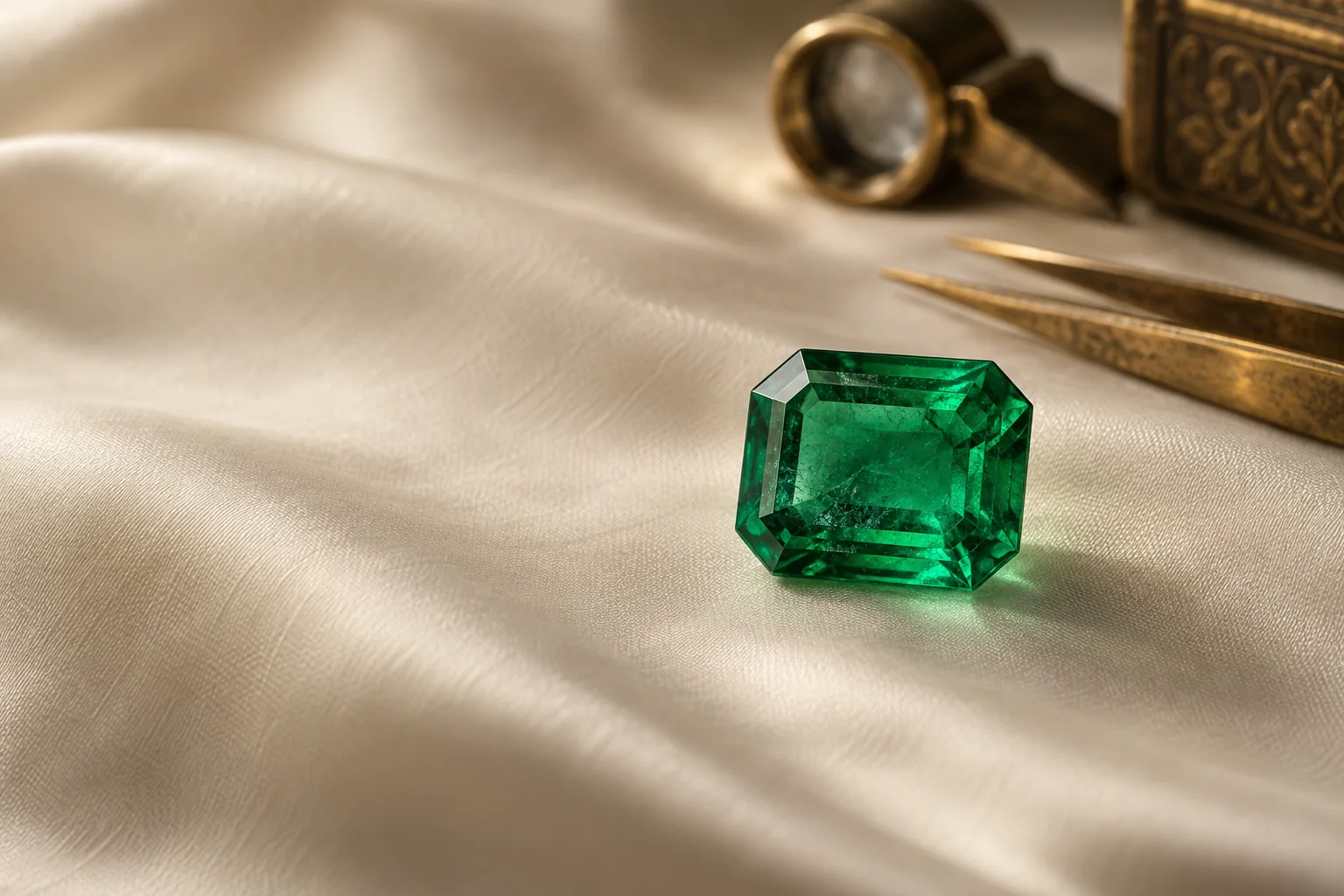
Emeralds have been the historic standard for green for thousands of years: gems of gardens, empires and extraordinary high jewellery. This emerald buying guide explains Colombian and Zambian origins, colour, clarity, treatments, value, care and the documents to request before buying.
Colour leads. Fine emeralds show a vivid bluish green to pure green hue, attractive transparency and an even appearance. Size, cut, clarity, treatment level, laboratory-confirmed origin and provenance can then change value dramatically.
The legacy of emeralds
Emerald has represented fertile landscapes, renewal and power for millennia. GIA records early Egyptian mines as being worked as far back as about 3500 BC. Centuries later, the intense green gems of Colombia entered European royal and mercantile networks, while Indian courts and jewellers developed sumptuous combinations of carved emerald, gold, enamel and diamonds.
That history still shapes modern taste. Art Deco designers used the rectangular emerald cut for crisp geometry; twentieth-century collectors made large Colombian stones signatures of personal style; contemporary houses set emeralds in both restrained solitaires and high jewellery colour compositions. The gem’s inclusions—poetically called a jardin, or garden—can make every stone visibly individual.
Legacy should be documented, not romanticised. A named mine or royal-sounding story does not prove origin. For an important emerald, provenance records and an independent origin report are distinct sources of value.
How emerald quality and value are judged
| Factor | Why it matters | What to examine |
|---|---|---|
| Colour | The dominant value factor. | Bluish green to pure green, vivid saturation, a tone that is rich without becoming too dark, and even distribution. |
| Transparency | Brightness and life can outweigh the pursuit of flawlessness. | Whether inclusions interrupt light, create haze or threaten durability. |
| Cut | Balances colour, weight and fragile areas. | Even brightness, pleasing outline, protected corners and no obvious window through the centre. |
| Size | Fine large emeralds are rare. | Carat weight and millimetre dimensions; emerald is less dense than diamond and can appear larger at the same weight. |
| Treatment and origin | Can materially affect rarity and price. | Independent identification, treatment extent and an origin opinion where justified. |
Unlike diamonds, coloured stones do not use a single universal grading scale. GIA identifies emerald and detectable treatments but does not issue an overall quality grade. Compare actual stones in consistent lighting and read the laboratory report rather than relying on a seller’s invented letter grade.
Colombian, Zambian and other emerald origins
Colombia is the classic source associated with Muzo, Chivor and Coscuez and with highly saturated greens that have shaped the market’s ideal. Zambia, particularly the Kafubu area, is a major source known for stones that can show a cooler bluish-green character. Brazil, Ethiopia, Afghanistan and other regions also produce fine emeralds.
Origin is not a shortcut to quality. Every deposit produces a range. A superb Zambian emerald can be more beautiful and valuable than a commercial Colombian stone. For exceptional gems, an independent laboratory’s origin opinion may add confidence and context, but colour, transparency, cut, size and treatment still determine the individual stone’s appeal.
Emerald oil and clarity enhancement
Because emerald crystals commonly contain surface-reaching fissures, many stones are filled with oil, resin or another substance to reduce their visibility. This can improve apparent clarity, and the practice is widely encountered, but the treatment must be disclosed. Laboratories may describe the degree of clarity enhancement as minor, moderate or significant.
Enhancement level affects rarity, price and care. Fillers can dry out, change appearance or be damaged by heat and chemicals. Ask what substance was used, whether re-treatment may be needed and how a repair or cleaning method could affect it. Avoid ultrasonic and steam cleaning unless a qualified professional has confirmed they are safe for that specific stone and treatment.
Emerald buying checklist
- Decide whether colour, origin, size or low treatment is your priority.
- View the stone in daylight-equivalent and indoor lighting; reject excessive darkness or a lifeless centre.
- Inspect inclusions from face-up and side views, especially surface-reaching fissures near corners.
- For a significant purchase, request an independent coloured-stone identification report with treatment disclosure.
- Request an origin opinion only when it is meaningful to the price and supplied by a respected laboratory.
- Choose a protective setting and a jeweller experienced with emerald’s relative brittleness.
- Put treatment, return terms, provenance and aftercare in writing.
How to care for emerald jewellery
Use lukewarm water, mild soap and a soft brush, then dry gently. Avoid sudden temperature changes, harsh chemicals, steam and ultrasonic cleaning. Remove emerald rings for impact-prone work and store them separately. Tell any jeweller that the piece contains emerald before polishing, resizing or repair so heat and cleaning methods can be controlled.
Emerald frequently asked questions
Are Colombian emeralds always the best?
No. Colombia has immense historical prestige, but every source yields a quality range. Judge the individual stone and use a laboratory origin opinion for high-value claims.
Are inclusions normal in emeralds?
Yes. Eye-visible inclusions are common and accepted. The key questions are whether they reduce transparency, beauty or durability.
What does “minor oil” mean?
It indicates a relatively small degree of clarity enhancement detected by the reporting laboratory. Read the exact report language; different laboratories may use different systems.
Can emerald be worn every day?
It can be worn regularly in a well-designed protective setting, but it needs more care than diamond, ruby or sapphire. Avoid hard knocks, heat and inappropriate cleaning.
Sources and further reading
Editorially reviewed 14 September 2026. Educational information only; seek an independent gemologist for a high-value purchase.